
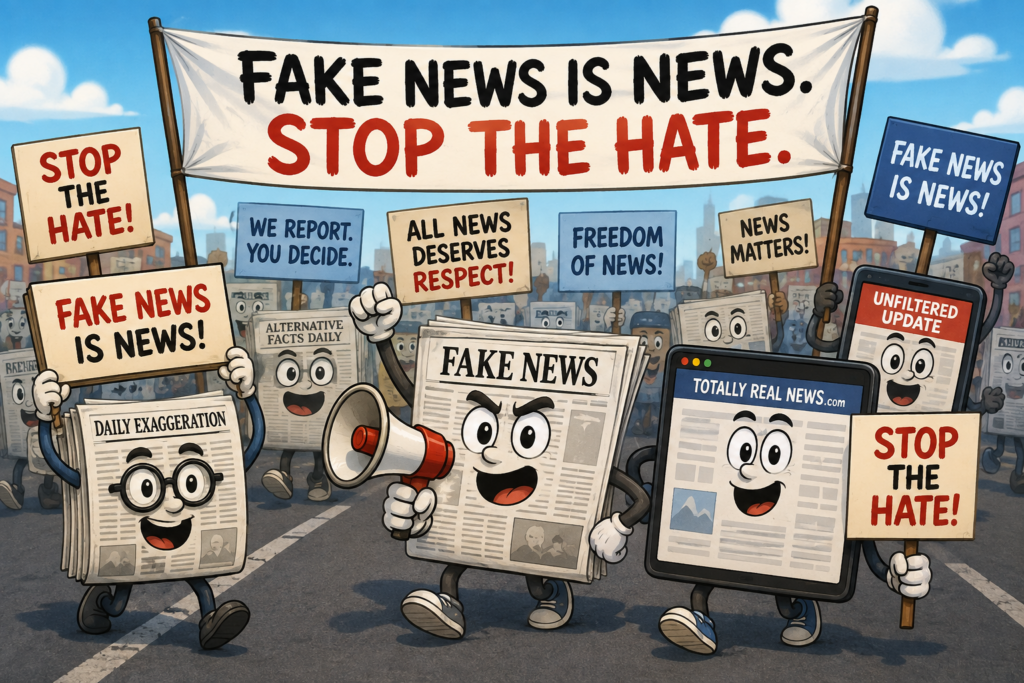
An opinion from Fake News, who is frankly tired of your shit.
Hi. Fake News here.
Apparently I’m responsible for everything now. Election result you don’t like? Fake News. Poll says your candidate is losing? Fake News. Your uncle shares a post claiming Congress secretly passed a law requiring every American to surrender one kidney to Ukraine? Also Fake News.
I understand some of this. I am literally Fake News. Getting blamed comes with the job.
But you’ve destroyed the meaning of my own name, and I’d like it back.
I AM FAKE. THAT DOESN’T MEAN I’M NOT NEWS.
Fake news is false information presented as news. Sometimes somebody makes it up on purpose — that’s disinformation. Sometimes somebody believes the bullshit and passes it along without checking — that’s misinformation. Different problem. Same bullshit.
But whether something is false and whether it becomes newsworthy are two different questions.
Say somebody invents a story tomorrow claiming the president secretly lives in a bunker under a Costco. Obviously false. Probably. But five million people share it. Politicians get asked about it. Protesters show up outside Costco. Costco stock drops because half the country thinks the rotisserie chickens are funding the deep state.
At that point the bunker is still fake. The reaction isn’t. Money moved. Real institutions had to respond to something that never happened.
That’s news. I win either way, and honestly, that should bother you more than it bothers me.
YOU DESTROYED MY BRAND
Here’s my actual complaint. Nobody checks whether I’m even fake anymore. “Fake News” now just means: false story, story I dislike, outlet I dislike, poll I dislike, fact I wish had stayed private. Those are not the same thing. A fabricated quote is fake. A real quote you regret saying is not. A doctored photo is fake. An ugly photo of you is still an ugly photo of you. Sorry. You can’t fact-check your chin.
And it’s not just politicians. Normal people do it too. Something attacks their side and suddenly everybody’s a forensic analyst — source, context, who funded the study. Good questions. Then something equally ridiculous shows up about the other side and the standard becomes “well, I wouldn’t be surprised.” Evidence is apparently optional the moment the bullshit is convenient.
I’ll give you this much, though. I don’t do it alone. I need you to skip the reading part first.
YOU CLICK EVERYTHING
I don’t force myself on anyone. You click me. Pew has found that more than half of American adults get news from social media at least sometimes, and people frequently share links without opening them. Come to think of it, that explains most of my career.
A headline saying ECONOMIC POLICY PRODUCES COMPLICATED RESULTS is boring. Nobody shares that. Change it to LEAKED REPORT EXPOSES SECRET PLAN THAT COULD DESTROY AMERICA and suddenly Gary from accounting has concerns. He hasn’t read the report. He hasn’t clicked the article. But Gary has concerns.
Research backs this up — false information tends to spread faster and farther online than true information. That doesn’t mean every viral story is false. It means bullshit has a head start. Truth has paperwork. I can just make things up, and I’ll admit that’s a genuinely unfair advantage. I don’t lose much sleep over it, but I’d be lying if I called it a fair fight. And I’m allowed to lie. That’s kind of the whole thing.
THE PROBLEM ISN’T ONLY ME
Fine. I’ll defend you a little.
Most people probably do care whether something is true. Reuters Institute’s 2025 Digital News Report found 58% of people across 48 markets worried about telling real information from false online — in the U.S., 73%. So people know there’s a problem.
Knowing there’s a problem and recognizing it when it’s on your side, though, are apparently different skills. Studies have found that when people are pushed to care about accuracy, they get better at spotting false headlines. When the incentive shifts to pleasing their political tribe, accuracy tanks. That tracks. People don’t only share things because they believe them. Sometimes they share things because they want them to be true. There’s a difference, and that gap is where I do my best work. I’m not proud of that. Actually, I am, a little. Hahaha.
STOP HATING ME, START DOING YOUR JOB
I’m not asking you to believe me. Please don’t. Check sources. Read past the headline. Find the original quote. See whether five sites are actually reporting five things or just copying the same idiot.
But stop pretending I disappear the moment someone proves me false. Sometimes proving a story false is the story. Sometimes the real question isn’t whether millions of people were right. It’s why they wanted to be right badly enough to stop checking.
I can be completely fake and still produce completely real consequences. That’s the part everyone misses, including, if I’m honest, the people who run me. We built an entire business model on you not reading past the headline, and calling that a “media strategy” instead of what it actually is. So no, I’m not innocent in this. I just don’t think I’m supposed to be the only guilty party in the room.
Next time you’re about to share something because it feels true rather than because you checked whether it is — because it makes your side look right, or the other side look stupid — ask yourself one honest question before you hit the button: are you sharing this because you verified it, or because you were hoping I’d already done that part for you?