
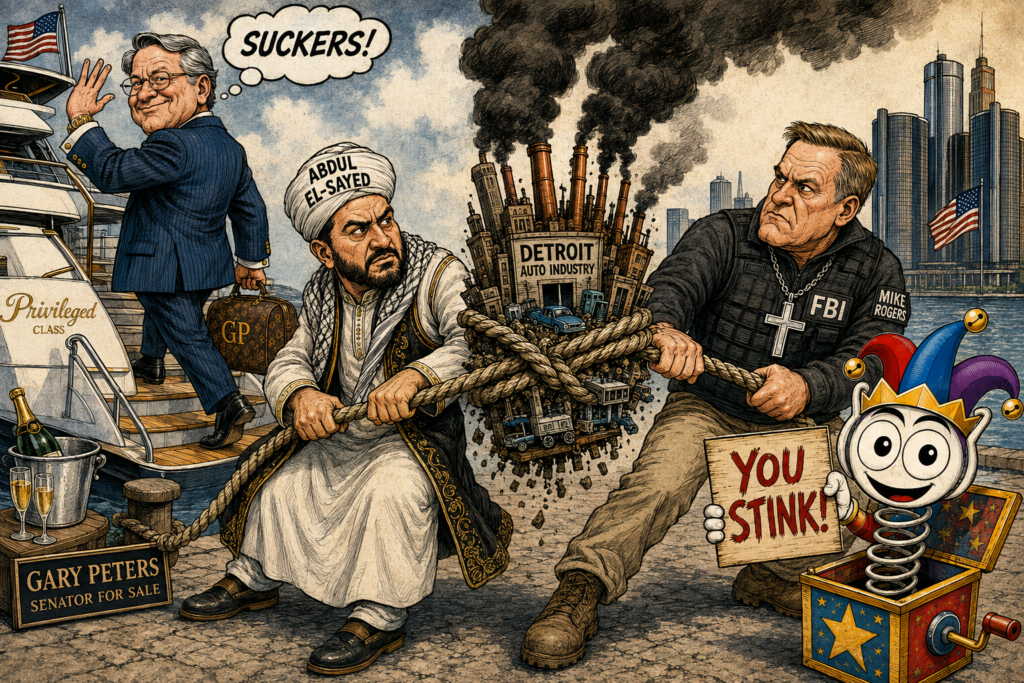
Michigan’s Senate race is actually pretty simple.
Gary Peters is retiring.
Mike Rogers wants the Senate seat he almost won in 2024.
Abdul El-Sayed survived a Democratic primary where more than $40 million in outside money poured into the race and still beat the establishment candidate, Haley Stevens.
Now both men are telling Michigan workers that they are the guy who will protect manufacturing.
Detroit gets to stand in the middle and hold the rope.
I actually think both candidates understand the basic problem.
Michigan cannot survive on politicians saying “working families” every six minutes while the auto industry gets pulled toward China, Mexico, Canada, cheaper labor, automation or whatever country somebody discovered this week can manufacture the same part for twelve dollars less.
The disagreement is over what to do about it.
That part matters.
Because Michigan has heard promises about bringing manufacturing back before.
A lot.
GARY PETERS LEAVES A VERY EXPENSIVE CHAIR
Peters announced in January 2025 that he would retire after two Senate terms.
I understand him.
He is 67. He served in the Michigan Legislature, three terms in the House, two terms in the Senate and ran the Democratic Senatorial Campaign Committee through two election cycles.
At some point you are allowed to go home.
Unfortunately for Democrats, Peters going home means they have to defend an open Senate seat in a state Donald Trump won in 2024.
And Republicans already have a candidate who came extremely close to winning it.
Rogers lost to Elissa Slotkin in 2024 by 19,006 votes.
That is basically nothing in a statewide election with more than 5.5 million votes cast.
If Rogers had convinced a few thousand more people in a handful of communities that he was slightly less annoying than the alternative, he would already be Senator Rogers.
So I understand why he came back.
He almost won.
Run again.
Democrats, meanwhile, had their own problem.
Haley Stevens was supposed to be the safer candidate.
She was an incumbent congresswoman. She had establishment support. Outside groups spent heavily on the race. More than $40 million came in from outside groups supporting Stevens or attacking El-Sayed.
El-Sayed still won.
Barely.
But barely counts.
He ran on Medicare for All, unions, corporate power, affordability and getting money out of politics. He had Bernie Sanders. He had the UAW. He also had an extremely simple message.
Money out of politics.
Money in your pocket.
Medicare for All.
I don’t agree that Medicare for All automatically fixes American healthcare because nothing involving the federal government and several trillion dollars automatically fixes anything.
But I understand the pitch.
Your healthcare costs too much.
Your rent costs too much.
Your groceries cost too much.
Some corporation is making record profits.
I am going after them.
You can disagree with the solution without pretending the message is complicated.
It isn’t.
The latest Michigan State University poll has El-Sayed ahead of Rogers 50% to 45% among likely voters.
Five points.
Not safe.
Not terrible.
Michigan.
Rogers learned that lesson personally two years ago.
BOTH MEN HAVE NOW DISCOVERED THE FACTORY
This election is going to be sold as socialism versus capitalism, Trump versus the left, Muslim versus Christian America, MAGA versus Bernie Sanders, and probably six other things before November.
But underneath all of that is a much more boring question.
Jobs.
Specifically good jobs.
Rogers wants tax cuts, more manufacturing, more housing and more skilled-trades education. He has pushed putting shop class back into Michigan high schools and argues that the state needs workers who can actually build things.
I agree with him on that.
We spent decades telling every teenager that success meant going to college, sitting in an office and eventually attending meetings about future meetings.
Then everybody became surprised when plumbers started charging $300 to come to the house.
Turns out civilization still requires somebody who knows what a pipe does.
Rogers also talks constantly about bringing manufacturing back to Michigan.
Again, I agree.
El-Sayed does too.
That is where this race becomes more interesting than the campaign ads make it sound.
El-Sayed is not arguing for completely free trade.
He supports targeted tariffs.
He wants investment in American manufacturing.
He supports unions and the PRO Act.
He wants stronger antitrust enforcement and restrictions on stock buybacks.
The UAW endorsed him before the primary and stayed with him.
So this is not really:
Republican wants factories.
Democrat wants everyone to major in gender studies and make pottery.
Both candidates say they want factories.
The argument is over who gets protected, who pays and how much government should interfere to make it happen.
That is a legitimate argument.
Then Donald Trump brought Canada into it.
Now everything gets stupid.
DETROIT IS HOLDING THE ROPE
Trump’s trade war with Canada has become a major problem for this race because Michigan does not merely trade with Canada.
Michigan manufactures things with Canada.
That distinction matters.
The auto industry on both sides of the border has spent decades building one integrated supply chain.
Engines.
Transmissions.
Steel.
Aluminum.
Seats.
Electronics.
Finished vehicles.
Parts cross the border.
Then sometimes they cross again.
A vehicle can contain American parts, Canadian parts and Mexican parts before somebody in Michigan finally tightens the last bolt and puts it on a truck.
That may be stupid.
Maybe North American manufacturing should never have become this dependent on crossing borders.
I am open to that argument.
But that is the system we actually have.
You cannot pretend it disappears because someone signed a tariff proclamation.
In August, Trump threatened to raise tariffs on Canadian cars, trucks and auto parts to 50% starting January 1, 2027 after trade talks collapsed.
The fight escalated again this week, with Canada imposing retaliatory tariffs on $20 billion in American goods and Trump announcing additional restrictions and import bans on selected Canadian products.
Rogers argues that tariffs can be necessary to protect Michigan autoworkers.
He specifically says Canada wants hundreds of thousands more Canadian-built vehicles entering Michigan and that American workers should build those cars instead.
There is logic there.
I don’t believe free trade automatically benefits American workers simply because an economist produced a graph.
Michigan has plenty of empty factories available if somebody wants historical evidence.
But tariffs are tools.
A hammer is useful.
That does not mean you repair your kitchen by beating every appliance with it.
The UAW’s position is actually pretty reasonable.
The union supports strategic tariffs and openly says the free-trade system screwed workers.
But after Trump’s latest escalation, UAW President Shawn Fain said the union rejects escalation against Canada, specifically because Canada has strong unions and labor standards.
That distinction makes sense to me.
If a company moves production somewhere because workers make $3 an hour and independent unions are crushed, tariff the hell out of it.
I can defend that.
But Canada is not Vietnam.
Ontario autoworkers are not assembling trucks barefoot for a bowl of rice.
They are union workers operating inside essentially the same North American manufacturing system as Michigan.
El-Sayed has attacked Trump’s Canada tariffs as chaotic while supporting targeted tariffs elsewhere.
So once you remove the campaign garbage, both sides actually agree on more than they admit.
Free trade hurt American manufacturing.
China is a serious problem.
Tariffs can be useful.
Domestic manufacturing matters.
The real disagreement is where to swing the hammer.
That is the argument Michigan should be having.
Instead we got JD Vance.
OBVIOUSLY WE NEEDED RELIGION TOO
Vance came to Michigan and called El-Sayed “very, very evil.”
Republicans have also attacked El-Sayed over comments following an attack on a Jewish synagogue, his past statements about Israel and his appearances with controversial figures on the left.
Some of that criticism is legitimate.
El-Sayed is running for the United States Senate.
His statements matter.
Who he campaigns with matters.
His positions on Israel matter.
If he says something stupid, criticize it.
He has also apologized for some comments.
Fine.
Judge the apology too.
But El-Sayed is Muslim, and Republicans have increasingly made that part of the broader argument against him.
That is where I lose interest.
I care what the guy believes.
I care what he would vote for.
I care what his economic policies would do.
I care what he thinks about Israel, Iran, healthcare, taxes and manufacturing.
I do not care which direction he faces when he prays.
Maybe I am old-fashioned.
If El-Sayed secretly wants to impose Sharia law on Michigan, show me the proposal.
Then we have a problem.
If the evidence is simply that his name is Abdul and he attends a mosque, that is not an argument.
Rogers deserves the same standard.
He has aligned himself closely with Trump.
Fine.
Then when Trump’s policies affect Michigan, Rogers owns his answer.
He cannot campaign as Trump’s guy when Trump is popular and suddenly become Mike Independent when tariffs start hitting Detroit.
That is the job.
Defend it.
El-Sayed cannot run as the working-class alternative and then pretend the expensive parts of his progressive agenda do not exist.
Defend those too.
I don’t want candidates protected from criticism.
I want better criticism.
Michigan has an auto industry facing Chinese competition, a trade war with Canada, expensive healthcare, expensive housing and a workforce trying to figure out what manufacturing looks like twenty years from now.
There is plenty to argue about.
We do not need to manufacture additional bullshit.
DETROIT HAS SEEN THIS MOVIE
This is ultimately what bothers me about the race.
Every politician running statewide in Michigan suddenly becomes extremely interested in factories.
They put on safety glasses.
They walk around plants.
They shake hands with workers.
Republicans explain that taxes and regulations destroyed manufacturing.
Democrats explain that corporations and trade deals destroyed manufacturing.
Both explanations contain some truth.
Then the election ends.
Detroit keeps holding the rope.
For decades, American companies moved production somewhere cheaper.
Workers were told this was globalization.
Factories closed.
Communities got poorer.
Then politicians decided China had become too powerful.
Correct.
Then everybody wanted manufacturing back.
Also correct.
Now the United States is trying to rebuild domestic manufacturing while simultaneously fighting with Canada, which happens to be attached to Michigan’s existing manufacturing system.
Meanwhile China is not waiting for us to finish the argument.
Chinese automakers are getting better.
Their EV industry is enormous.
Their costs are lower.
Their companies want international markets.
That threat is real.
So I actually do not think this election requires choosing between “tariffs good” and “tariffs bad.”
That is too stupid.
The question is whether the tariff produces something.
Does the factory come back?
Does Michigan gain jobs?
Do wages increase?
Does American production increase?
Or does the consumer simply pay more while politicians declare victory?
Same with El-Sayed’s policies.
Does Medicare for All actually reduce what a Michigan family spends on healthcare after taxes?
Does stronger union power increase wages without driving investment somewhere else?
Does banning stock buybacks create more investment in workers or just create another way for companies to move money around?
Those are fair questions.
Answer them.
Rogers should explain exactly what happens to Michigan’s auto supply chain if the Canada fight keeps escalating.
El-Sayed should explain exactly how his major spending proposals get paid for.
Then voters can choose.
Because right now both candidates are pulling on the same thing.
Rogers says Trump, tariffs and domestic production will save Michigan manufacturing.
El-Sayed says unions, targeted tariffs and government intervention will save Michigan manufacturing.
Washington wants control of the Senate.
Trump wants another loyal Republican.
Democrats desperately need to keep Peters’ seat.
Outside groups are dumping money into Michigan.
Everybody has grabbed the rope.
And Detroit is still tied to the middle.
Maybe one of them really does have the answer.
I could be wrong.
But Michigan has been promised the return of American manufacturing for a very long time.
So before voters hand either Mike Rogers or Abdul El-Sayed six years in the United States Senate, I would ask one question.
When everybody finishes pulling, what exactly is Detroit supposed to have left?