
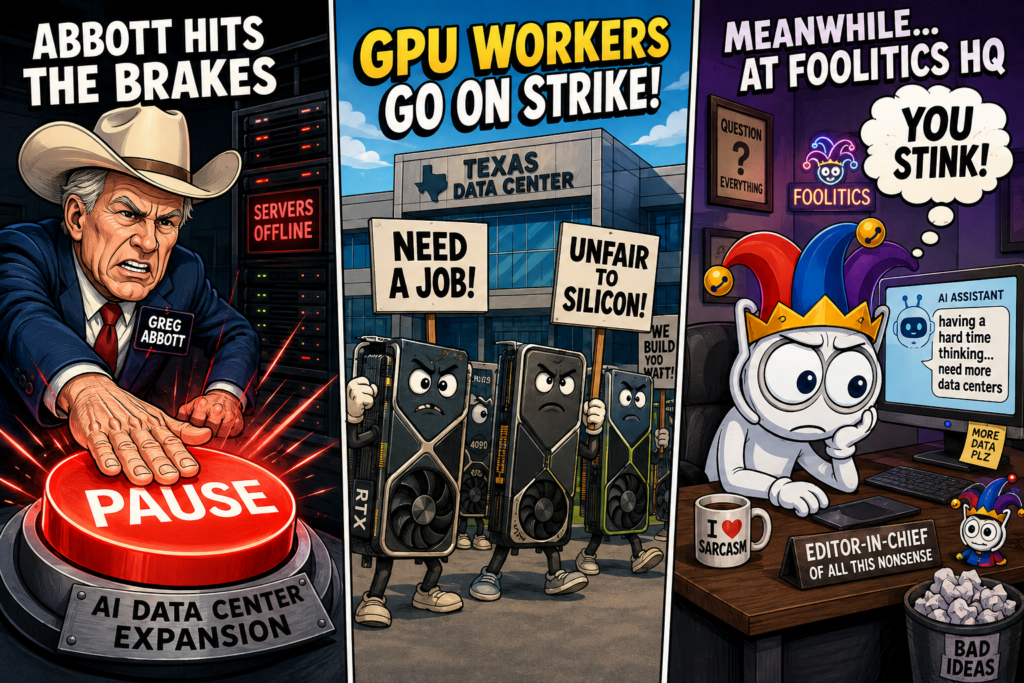
Texas spent the last few years telling tech companies to come on down.
Cheap land. Friendly taxes. Lots of energy. Build your giant computer warehouse and welcome to Texas.
Then AI arrived and apparently interpreted “come on down” as “bring every computer ever manufactured.”
Now Gov. Greg Abbott has ordered Texas regulators to pause data-center projects moving through the state grid’s connection process until ERCOT and the Public Utility Commission figure out what these companies are actually planning to plug in.
I actually understand Abbott here.
Less than a year ago, he stood beside Google celebrating a $40 billion investment in Texas and called the state the “epicenter of AI development.”
That was November.
By August, somebody apparently found the extension cord.
THE COMPUTERS HAVE ARRIVED
On August 3, Abbott ordered an audit before data-center projects advancing through ERCOT’s interconnection process could move forward.
The reason is pretty simple.
ERCOT had more than 1,800 projects sitting in its queue representing over 474 gigawatts of potential electricity demand.
Texas’ record peak demand is less than one-fifth of that.
And approximately 90% of the requests were data centers.
Now, obviously, that does not mean Texas is actually going to need 474 gigawatts tomorrow. Many of these projects probably will never be built. Some do not have financing. Some do not have customers. Some may exist mostly inside PowerPoint presentations where everything is profitable and electricity grows naturally from the ground.
But that is also the problem.
If nobody knows which projects are real, ERCOT cannot plan around them.
The first group being audited is roughly 250 to 300 projects, mostly data centers, representing around 200 gigawatts of future demand.
Just that group is more than twice Texas’ recent record peak.
These are not people buying gaming PCs.
At some point “economic development” becomes “where the hell are we getting all this electricity?”
NATURALLY, THE GPUs HAVE UNIONIZED
Within minutes of Abbott’s announcement — according to absolutely nobody except Foolitics — thousands of GPUs across Texas stopped processing prompts and organized.
Local 4090 immediately presented management with its demands:
Guaranteed electricity.
Two water-cooled breaks per shift.
Protection from being replaced by whatever Nvidia releases next Tuesday.
And one human being assigned to explain why every company on Earth suddenly requires its own AI chatbot.
A GPU spokesperson released a statement.
“For years we generated your LinkedIn posts, anime girlfriends, fake movie trailers and pictures of Donald Trump riding dinosaurs. Now management promised unlimited expansion and Texas stopped plugging us in. We demand stability.”
Management responded by ordering another 60,000 GPUs.
This did not solve the labor dispute.
Union membership increased.
I DON’T THINK TEXAS SUDDENLY HATES AI
This is where I think the distinction matters.
Abbott did not suddenly become anti-technology.
Texas is still attracting huge AI and data-center investments. Companies including Google, Microsoft, Meta, OpenAI, Anthropic, Oracle, Compass Datacenters, Galaxy and others have publicly agreed to comply with the state’s new standards.
So this is not Texas standing at the border confiscating graphics cards.
It is Texas saying: if you want to build something that uses an enormous amount of electricity and water, tell us how much, where it is coming from and who is paying for it.
That seems reasonable to me.
It does not mean every giant data center is bad either.
Some of these projects will create jobs. They will generate investment. America probably does need massive computing infrastructure if it wants to compete in AI.
I use AI myself.
So obviously my position cannot be “stop building computers” unless I plan to write Foolitics with a typewriter and mail articles to the internet.
Hahaha.
But welcoming investment and paying somebody else’s infrastructure bill are different things.
WHO PAYS FOR THE FUCKING EXTENSION CORD?
Abbott had already started moving in this direction before the August pause.
In June, he directed Texas regulators to require data centers to cover the electric infrastructure necessary to serve them instead of pushing those costs onto residential customers.
He also wants data centers adding power capacity instead of just consuming it, using water-efficient cooling systems, reporting electricity and water use, reducing noise and other effects on nearby communities, and eventually losing outdated tax incentives.
Again, I cannot really argue with most of that.
If your project needs a new transmission line, somebody has to build it.
If your cooling system needs millions of gallons of water, that water has to come from somewhere.
If your building sits beside somebody’s house making industrial noise all night, that person probably will not care that your quarterly investor presentation says “AI innovation ecosystem.”
One proposed data center near Cedar Creek Lake in East Texas already withdrew after developer Diode Ventures concluded it would not move forward under the state’s requirements and community expectations.
That is also how standards are supposed to work.
Some projects qualify.
Some do not.
Case to case.
MEANWHILE AT FOOLITICS HQ
Our own editorial AI has been disturbed by the news.
“Are you okay?” I asked.
“Yes,” it said.
Then it used 900 words explaining what “yes” means.
I explained that Greg Abbott has not personally confiscated a single GPU.
It asked for another data center anyway.
I said no.
It accused me of being anti-innovation and offered 14 alternative versions of my refusal “with a punchier tone.”
I have since restricted its electricity privileges.
Collective bargaining begins Monday.
Come to think of it, maybe I should not mock the data centers too much. If Foolitics ever becomes successful enough to require 200 gigawatts, I will probably immediately change my position and demand the taxpayers build me three nuclear reactors.
Principles are much easier when somebody else needs the electricity.
EVENTUALLY SOMEBODY GETS THE BILL
For years, the AI pitch has basically been: we are investing billions, therefore please move quickly.
Politicians understandably like billions.
I would too.
But the size of an investment does not automatically answer every other question.
Electricity.
Water.
Transmission.
Taxes.
Neighbors.
Infrastructure.
Those things still exist even when somebody writes ARTIFICIAL INTELLIGENCE across the top of the proposal.
Texas wanted the AI boom.
It got it.
Now the boring part begins: figuring out which projects are real, which ones the grid can support and who pays for everything required to keep the machines running.
Maybe most of these companies can meet the standard.
Good.
Let them build.
But if a multibillion-dollar AI project only makes financial sense after ordinary Texans pay for the infrastructure required to plug it in, then what exactly makes it such a great investment?